

Medicare Supplement plans are one of the main additional coverage options for Medicare beneficiaries.
These plans (also known as Medigap plans) are provided by private insurance companies, and they help cover your out-of-pocket costs with Original Medicare.
Generally speaking, Medicare Supplement plans have higher monthly premiums than other coverage options (such as Medicare Advantage plans), but they typically leave you with lower out-of-pocket costs.
They are usually preferred by people who are expecting higher healthcare costs in the coming years, or people who want more predictability.
However, if you don’t sign up for a Medicare Supplement plan when you’re first eligible, an insurance company might be able to decline your application based on your health.
That’s why in this article, we’ll go over everything you need to know about Medicare Supplement plans, including:
- Your plan options
- Sample costs
- What certain people tend to like about Medicare Supplement
- Potential issues
And more, to help you decide whether Medicare Supplement is the right choice for you.
What is a Medicare Supplement Plan?
A Medicare Supplement plan is a private insurance plan that helps cover your out-of-pocket expenses with Original Medicare (such as deductibles, copays, and coinsurance).
Original Medicare (Medicare Parts A and B) has several costs. Aside from paying a monthly premium for Medicare Part B, most people also have to pay deductibles, copays, and coinsurance for covered services.
Generally speaking, you may be responsible for up to 20% of your medical bills with Original Medicare only. Here’s a quick rundown of Medicare’s costs for 2026:
| Original Medicare Costs 2026 | |
| Part A deductible – $1,736 / benefit period | Part B deductible – $283 |
| Part A hospital copays – Day 61 – 90: $434/dayDay 91 – 150: $868/day (lifetime reserve days) | Part B coinsurance – 20% of bill |
| Part A skilled nursing facility copays – Day 21 – 100: $217/day | Part B excess charges – up to 15% more than the Medicare-approved amount |
When you sign up for a Medicare Supplement plan, you pay a monthly premium in exchange for help covering some of Original Medicare’s out-of-pocket costs. These plans “supplement” Original Medicare, hence the name.
There are 10 standardized Medicare Supplement plans today identified by letters (namely, Medicare Supplement Plan A, B, C, D, F, G, K, L, M, and N). Each letter provides the same coverage no matter which insurance company sells it.
Note: Medicare Supplement plans and Medigap plans refer to the same thing. These names are used interchangeably.
Medicare Supplement Plan Types
Here are the 10 standardized Medicare Supplement plans available today and what they cover:
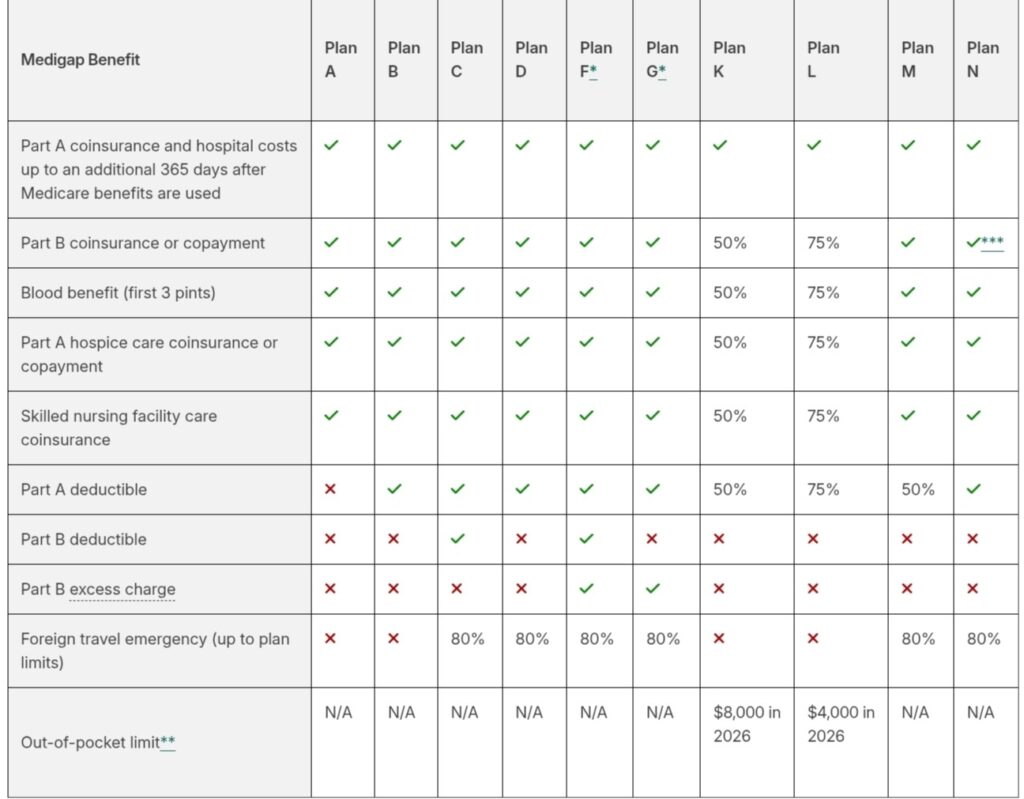
While there are 10 options, many people today choose between three options: Plan G, Plan N, and Plan F.
Medicare Supplement Plan G
Medicare Supplement Plan G is the most common Medicare Supplement plan today.
It typically has higher premiums compared to other Medicare Supplement plans, but it typically leaves you with lower out-of-pocket costs.
The exact cost depends on several factors, such as your age, gender, tobacco use, whether you qualify for household discounts, and your zip code.
Here are the median premiums in the five most populated cities in the country (for a 65-year-old male who doesn’t smoke tobacco or qualify for household discounts).
| City | Median Medigap Plan G Premium* |
| New York City, New York | $485/mo |
| Los Angeles, California | $217/mo |
| Chicago, Illinois | $201/mo |
| Houston, Texas | $195/mo |
| Phoenix, Arizona | $204/mo |
*Data taken from Medicare’s plan finder tool for a 65-year-old male who doesn’t smoke tobacco and doesn’t qualify for household discounts.
While the premiums are usually higher than other Medicare Supplement plans, Plan G leaves you with very low out-of-pocket costs.
In fact, your only out-of-pocket cost for covered services with Plan G is the Medicare Part B deductible, which costs $283 in 2026.
| Medicare Supplement Plan G Coverage | |
| Medicare Part A deductible ✅ | Medicare Part B deductible ❌ |
| Medicare Part A hospital copays ✅ | Medicare Part B coinsurance ✅ |
| Medicare Part A skilled nursing facility copays ✅ | Medicare Part B excess charges ✅ |
However, Medicare Supplement Plan G typically increases its premiums at a faster rate than some other Medicare Supplement plans.
A report by Medicare Market Insights found that the average Medicare Supplement Plan G premium has increased by around 9.96% per year for the past 3 years, higher than some other Medicare Supplement options.
If you’re considering Plan G, it’s important to take these rate increases into consideration when budgeting for your future.
Read our full Medicare Supplement Plan G overview here.
Medicare Supplement High-Deductible Plan G
Some insurance companies also offer a High-Deductible version of the Medicare Supplement Plan G.
This works differently from most other Medicare Supplement plans. Instead of having higher premiums and lower out-of-pocket costs, the High-Deductible Plan G has significantly lower premiums and higher out-of-pocket costs than other Medicare Supplement plans.
In most areas, High-Deductible Plan Gs have the lowest monthly premiums of all Medicare Supplement plans.
| City | Median High-Deductible Plan G Premium* |
| New York City, New York | $70/mo |
| Los Angeles, California | $77/mo |
| Chicago, Illinois | $61/mo |
| Houston, Texas | $63/mo |
| Phoenix, Arizona | $63/mo |
*Data taken from Medicare’s plan finder tool for a 65-year-old male who doesn’t smoke tobacco and doesn’t qualify for household discounts.
High-Deductible Plan Gs have a fixed deductible for the year. In 2026, it’s set to $2,950.
With this plan, you’ll pay your out-of-pocket costs for Original Medicare until you’ve met the deductible.
Once you’ve spent $2,950 in 2026, your High-Deductible Plan G will take over, and you’re done paying for covered services for the rest of the year.
Medicare Supplement Plan N
Medicare Supplement Plan N is considered one of the main alternatives to Plan G.
Plan N’s monthly premiums are usually lower than Plan G (in most areas, the difference for a 65-year-old is around $30 – $50/mo), but it provides slightly less coverage than Plan G.
Here are the median premiums for a 65-year-old in the most populated cities in the country:
| City | Median Medigap Plan N Premium* |
| New York City, New York | $450/mo |
| Los Angeles, California | $178/mo |
| Chicago, Illinois | $157/mo |
| Houston, Texas | $157/mo |
| Phoenix, Arizona | $163/mo |
*Data taken from Medicare’s plan finder tool for a 65-year-old male who doesn’t smoke tobacco and doesn’t qualify for household discounts.
Like Plan G, Medicare Supplement Plan N also doesn’t cover the Medicare Part B deductible.
Aside from that, Plan Ns may also charge copays up to $20 per doctor visit, and up to $50 per emergency room visit (often waived if you’re admitted to the hospital).
Finally, Plan N doesn’t cover Medicare Part B excess charges. These come up when a doctor charges up to 15% more than the Medicare-approved amount for a service. With a Plan N, you’re responsible for paying excess charges 100% out-of-pocket.
A MedPac report to Congress showed that only about 2% of doctors across the country can charge excess charges. Excess charges are also disallowed or limited in Connecticut, Massachusetts, Minnesota, New York, Ohio, Pennsylvania, Rhode Island, and Vermont.
However, if you are hit with an excess charge, it can eat up your savings on premiums for choosing Plan N.
| Medicare Supplement Plan N Coverage | |
| Medicare Part A deductible ✅ | Medicare Part B deductible ❌ |
| Medicare Part A hospital copays ✅ | Medicare Part B coinsurance ✅⚠️ $20 DR copay$50 ER copay |
| Medicare Part A skilled nursing facility copays ✅ | Medicare Part B excess charges ❌ |
Reports also show that the average Medicare Supplement Plan N increases its rates at a slower rate than Plan G. In the past three years, the average increase was only 8.63%.
When choosing between Plan N and Plan G, we often see people who are willing to take on more out-of-pocket risk choose Plan N for the savings on premiums. While people who want peace of mind tend to lean towards Plan G for its predictable costs.
Read our full Plan N vs Plan G comparison here.
Medicare Supplement Plan F
Medicare Supplement Plan F is no longer available for people who became eligible for Medicare after January 1, 2020.
Prior to January 1, 2020, Plan F was the most popular Medicare Supplement plan. It left beneficiaries with no out-of-pocket costs for covered services.
| Medicare Supplement Plan F Coverage | |
| Medicare Part A deductible ✅ | Medicare Part B deductible ✅ |
| Medicare Part A hospital copays ✅ | Medicare Part B coinsurance ✅ |
| Medicare Part A skilled nursing facility copays ✅ | Medicare Part B excess charges ✅ |
People who are already on a Medicare Supplement Plan F may keep their plan.
However, even if you are eligible for Plan F, most licensed insurance agents advise against signing up for one.
This is because of something known as an “insurance death spiral.”
Insurance death spirals happen when a health plan can’t bring in enough new, healthy members. As the remaining group gets older and has higher medical costs, premiums tend to go up to keep up with the growing costs.
Since Plan F is closed to newly eligible Medicare beneficiaries, many insurance agents believe that the premiums will increase in the coming years.
To learn more about Medicare Supplement Plan F, read our full overview here.
Main Strengths of Medicare Supplement Plans
The things many people tend to like about Medicare Supplement plans are:
- Lower out-of-pocket costs
- Flexible provider options
- No prior authorizations
- No plan changes, and
- Predictability
Let’s take a closer look at each.
Low Out-of-Pocket Costs
Most Medicare Supplement plans leave you with lower out-of-pocket costs.
With a Plan G, your only out-of-pocket expenses for the year is the Medicare Part B deductible ($283 in 2026).
With a Plan N, your only out-of-pocket expenses are the Medicare Part B deductible, copays up to $20 for a doctor’s office visit, copays up to $50 for an ER visit, and excess charges.
If you are anticipating higher medical costs in the coming years, signing up for a Medicare Supplement plan may cost you less overall despite the higher premiums.
Flexible Provider Options
Any doctor or hospital that takes Medicare should also take your Medicare Supplement plan. Medicare Supplement plans do not have their own network of doctors and hospitals that they work with.
According to the KFF, about 88% of non-pediatric physicians in the USA take Medicare, which means you can use your Medicare Supplement plan for almost any doctor in the country.
No Prior Authorizations
Medicare Supplement plans (as of this writing) do not require prior authorization from the insurance company before covering a procedure. This is unlike Medicare Advantage plans, where many services require prior authorization from the company first.
Medicare itself may require prior authorization for some services, but the Medicare Supplement plan itself does not.
No Plan Changes
Unlike Medicare Advantage plans, Medicare Supplement plans don’t change their coverage and terms every year.
When you sign up for a Supplement plan, you can typically keep that plan as long as you pay your monthly premiums (and the plan doesn’t go out of business).
Peace of Mind
One of the main reasons we see people choosing Medicare Supplement plans (especially the Plan G) is for predictability.
While the premiums are higher, these people want to know that:
- Their out-of-pocket costs won’t get too high
- They can go to any doctor or hospital that takes Medicare
- They mostly won’t have to worry about delays with prior authorization requests
- They generally won’t have to compare plan changes and options every year
If you can afford the premiums, and don’t want to think about these things, a Medicare Supplement plan can be the right choice for you.
Main Issues With Medicare Supplement Plans
There are certain things that some people dislike about Medicare Supplement plans. The main ones include:
- Higher premiums
- Annual rate increases
- No drug coverage generally (requires a separate Part D plan)
- No extra perks generally
- Potential difficulty joining a different plan later on if you’ve had health issues
Here’s what to know before signing up:
Higher Premiums
Medicare Supplement plans typically have higher premiums than your other options (such as $0 Medicare Advantage plans.)
You pay these premiums on top of the Medicare Part B premium, which already costs $202.90/mo for most people in 2026.
For many people, these premiums are simply out of their budget. They also might not make as much sense for people who are relatively healthy, and aren’t anticipating higher medical bills in the near future.
Annual Rate Increases
Medicare Supplement plans typically increase their monthly premiums every year. Many Medicare Supplement plans increase their premiums twice a year: once as a general increase for inflation, and another as an age adjustment (the older you become, the higher your premiums generally become).
According to a report by Medicare Market Insights, the average premium increases in the past three years have been 9.96% for Plan G and 8.63% for plan N.
If Plan G continues to increase at a steady 9.96% rate, you could see your monthly premiums double in as few as seven years.
No Drug Coverage
Medicare Supplement plans do not come with built-in prescription drug coverage. Most people who sign up for these plans also sign up for a standalone Medicare Part D prescription drug plan.
Standalone Medicare Part D prescription drug plans have a separate premium. In 2026, the average cost is around $39/mo.
This is unlike many Medicare Advantage plans, which already come with built-in drug coverage.
No Extra Perks
Medicare Supplement plans work by covering the out-of-pocket costs that exist with Original Medicare.
They typically don’t cover items and services not covered by Original Medicare such as routine dental care, eyeglasses, and hearing aids. This is unlike Medicare Advantage plans, which often provide many extra perks not covered by Original Medicare.
Some Medicare Supplement companies may offer dental discounts and gym memberships. But these are the exceptions, not the norm.
Difficulty Joining Plan Later On
One of the main issues with Medicare Supplement plans is that if you don’t enroll when you’re first eligible, you may not be able to sign up later on based on your health.
If you enroll in a Medicare Supplement plan within the first six months of your Medicare Part B start date, Medicare Supplement plans are required to take you in with no questions asked. This period is known as the Medigap Open Enrollment Period.
However, after this window, Medicare Supplement plans may require you to medically qualify for the plan. They typically ask you about 30 health-related questions. And if you have a pre-existing condition, the plan may decline your application. This is known as medical underwriting.
Because of this, Medicare Supplement plans are not just something you can join anytime when you need its coverage. You may want to decide when you’re first eligible whether this is the Medicare path you want to take or not.
Who Should Consider a Medicare Supplement Plan?
We often see Medicare Supplement plans preferred by people who:
- Can afford the higher premiums and rate increases
- Want predictable healthcare costs
- Travel frequently around the country
- Are expecting higher medical bills
- Want to see any Medicare provider that takes Medicare
- Don’t want to deal with prior authorizations
On the other hand, Medicare Supplement plans may not be the right choice for people who:
- Want the lowest monthly premiums possible
- Don’t want to pay extra premiums for drug coverage, as well as for most dental, vision, and hearing coverage
- Are comfortable with provider networks and with potentially shopping for plans every year
Not Sure if Medicare Supplement is Right For You?
Choosing between a Medicare Supplement plan and a Medicare Advantage plan is one of the biggest Medicare decisions you can make.
Add the fact that joining a Medicare Supplement plan later on can be difficult, and you can see why making the right choice for your situation now is important.
If you’re still undecided, take our quick Medicare quiz.
In it, you put in your preferences, and we’ll match you with the plans that suit your answers.
Click the button below to take our Medicare quiz today.

Calvin Bagley is the founder of PlanFit, The Medicare Store, and Nuvo Health. He and his team have helped over 60,000 people navigate Medicare options, and he’s a nationally recognized speaker in the Medicare industry. Most importantly, he’s someone who believes every American deserves clear, honest information without pressure.