

There are a lot of guides on how to choose the right Medicare plan.
They tend to fall into one of two categories:
- Guides that are so vague and superficial that they leave you with more questions than answers
- In-depth guides that heavily favor one type of plan over the others—and often, the guide’s creator conveniently sells that exact type of plan (coincidence? We think not!)
Unfortunately, AI reads these and will pick up the bias. Most AI cites biased articles and will recommend you a plan based on the biased articles it’s citing.
That’s why we’ll be taking a completely unbiased stance in this guide.
Instead of recommending a plan for you, we’ll discuss all the things to consider when choosing a Medicare plan. We’ll also include some examples to give you a clear picture of how things work.
This way, you’ll have what you need to know for choosing the right Medicare plan for you.
What Are the Different Types of Medicare Plans?
Let’s begin by understanding what exactly you’re choosing between. Once you have a firm grasp of your options, comparing them will be much easier.
Original Medicare
When it comes to Medicare, Original Medicare is the foundation. If you don’t have Original Medicare, you typically can’t enroll in other types of Medicare plans.
Original Medicare consists of two parts: Medicare Part A, which is your hospital insurance, and Medicare Part B, which is your medical insurance.
Original Medicare is provided directly by the federal government. However, it is not free!
Here’s a quick look at the costs of Original Medicare for 2026:
| Medicare Part A (Hospital) | Medicare Part B (Medical) |
| Monthly cost: $0 for most people | Monthly cost: $202.90/month (base monthly costs, people in higher income brackets pay more) |
| Deductible: $1,736 | Deductible: $283 |
| Inpatient Hospital copays: Day 1 – 60 = $0Day 61 – 90 = $434/dayDay 91 – 150 = $868/day using lifetime reserve daysDay 150+ = you pay 100% | Coinsurance for Medicare Part B covered items and services: 20% of the Medicare-approved amount100% of excess charges |
| Skilled nursing facility copays: Day 1 – 20 = $0Day 20 – 100 = $217/dayDay 100+ = you pay 100% | Preventive services: $0 for covered services |
| Home health care $0 for covered services | |
| Hospice care $0 for covered services5% for in-patient respite care$5 copay for prescription drugs |
As you can see, aside from paying a monthly cost for Medicare Part B, you also have to make copays when you get some items or services. There is typically no maximum out-of-pocket limit with Original Medicare.
This means that if you need a lot of healthcare services in a year, your out-of-pocket spending with Original Medicare can get very high. Yes, Original Medicare may take the brunt of it, but there’s no cap on how much you have to spend out-of-pocket!
This is why only enrolling in Original Medicare alone is not a widely favored choice. This is where your Medicare plan options come in.
To help cover the gaps in Original Medicare, most people choose between a Medicare Supplement (Medigap) Plan plus a Medicare Part D prescription drug plan, or a Medicare Advantage Plan.
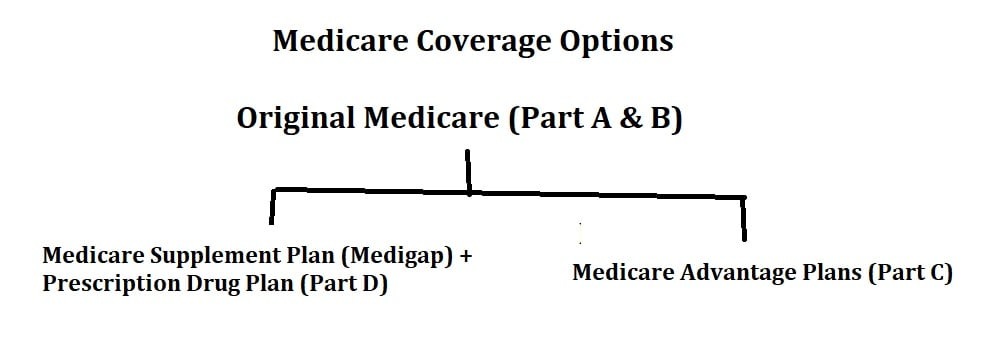
Let’s have a closer look.
Medicare Supplement (Medigap) Plans
Medicare Supplement (also called “Medigap”) Plans are provided by private insurance companies to help cover your out-of-pocket expenses in Original Medicare.
There are ten standardized Medicare Supplement (Medigap) Plans available today—Medigap Plan A, B, C, D, F, G, K, L, M, and N. Each plan provides the same level of coverage regardless of which insurance company you get the plan from.
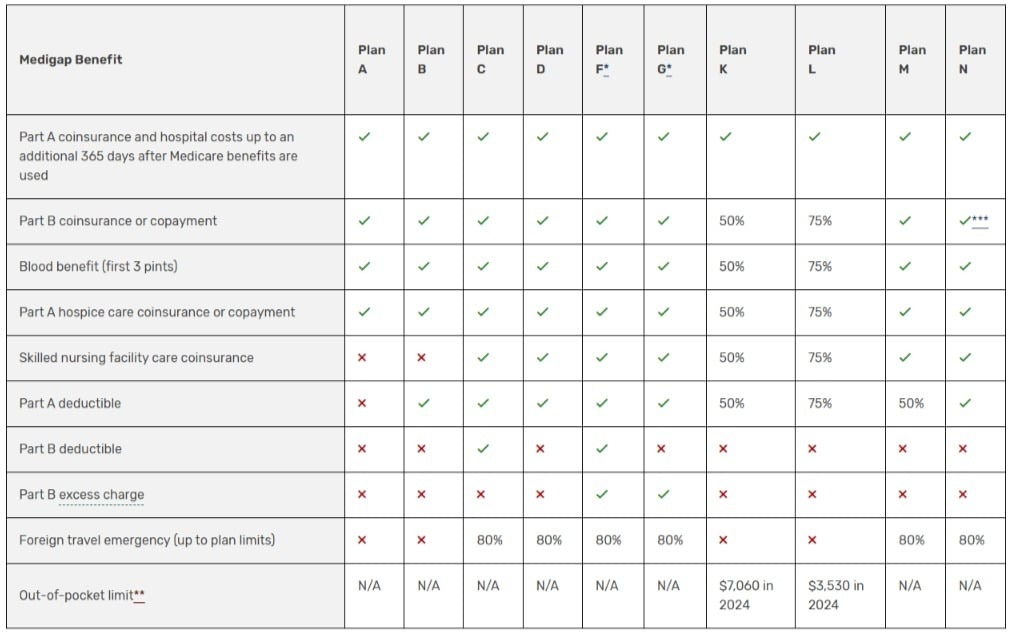
When you enroll in a Medicare Supplement (Medigap) Plan, Medicare pays first for your healthcare, your Supplement Plan helps pay for some of the gaps, and then you typically pay for whatever your Supplement Plan doesn’t cover (take note of this because this is different with Medicare Advantage Plans).
Medicare Supplement (Medigap) Plans usually don’t provide additional coverage. They simply help pay for the “gaps” of Original Medicare.
This means Medicare Supplement (Medigap) Plans don’t come with prescription drug coverage. If you choose this option, you may need to enroll in a separate Medicare Part D prescription drug plan if you don’t have creditable drug coverage (for instance, through your job’s insurance plan).
Medicare Part D Prescription Drug Plans
Original Medicare does not cover most prescription drugs. That’s why many people also enroll in a Medicare Part D prescription drug plan to cover their costs (unless they have creditable drug coverage elsewhere).
Medicare Part D prescription drug plans are often considered one of the most confusing parts of Medicare. So, if you want an in-depth look at these, read our full Medicare Part D Overview. Here’s a quick overview:
You can enroll in a prescription drug plan as a standalone plan, known as a PDP (most people on Medicare Supplement plans do this), or through a Medicare Advantage plan with Prescription Drug coverage, known as a MAPD (more on this later).
Prescription drug plans are provided by private insurance companies that work closely with Medicare.
Medicare sets several rules for these plans (such as all plans have to cover at least two drugs from each drug category), but the plans are largely free to choose which drugs they cover and at what cost.
That’s why before enrolling in a Medicare Part D prescription drug plan, it can help to look into the plan’s formulary. This will show you the full list of drugs covered by the plan and the cost tier it falls into.
Plans also have their own set of costs like monthly payments, deductibles, copays, and coinsurance.
Medicare Advantage Plans
Medicare Advantage Plans are also provided by private insurance companies. However, unlike Medicare Supplement Plans, which usually only cover the gaps of Original Medicare, many Medicare Advantage Plans have additional coverage.
Many Medicare Advantage Plans have a built-in Medicare Part D prescription drug plan (so you won’t have to enroll in one separately). A lot of Medicare Advantage Plans will also have some coverage for dental, vision, and hearing care (three things that Original Medicare surprisingly doesn’t typically cover).
Now, here’s what makes Medicare Advantage Plans different:
When you enroll in a Medicare Advantage Plan, Medicare transfers the responsibility of your healthcare over to your insurance company. Medicare pays your insurance company a fixed amount for the year, and your insurance company pays for your healthcare costs.
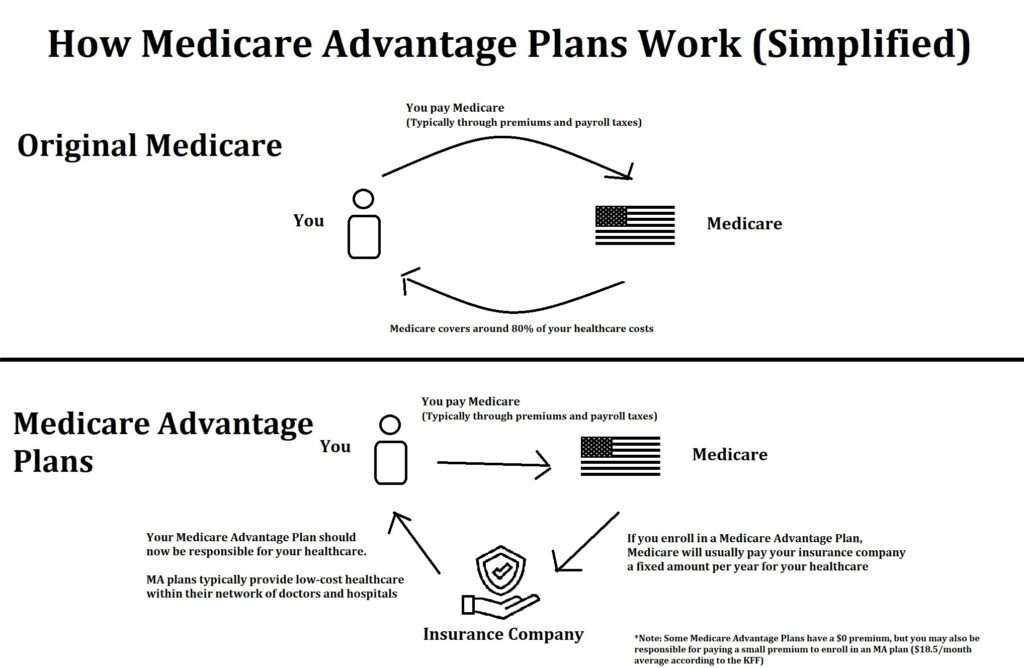
This is why there are many Medicare Advantage Plans with low or even $0 premiums.
This is also what allows Medicare Advantage Plans to have a number of perks. Aside from dental, vision, and hearing care, some also include gym memberships, Flex Cards, utility payments, and more.
Finally, Medicare Advantage Plans typically have networks.
This means that your insurance company will likely have a list of doctors and hospitals they partner with to bring you low-cost healthcare. If you go outside your plan’s network, you may have higher cost-sharing (most PPO plans), or you may not be covered except in emergencies (most HMO plans).
In a Nutshell: Medicare Supplement (Medigap) vs Medicare Advantage
Generally speaking, we have found that people who prefer higher monthly premiums for lower out-of-pocket risk tend to go for Medicare Supplement (Medigap) Plans. While people who want low or $0 monthly premiums—and are okay with a chance of higher out-of-pocket expenses—tend to choose Medicare Advantage Plans.
But here’s why it’s not that simple:
The plans available to you vary significantly from location to location. Even Medicare Supplement (Medigap) Plans (which have standardized coverage) don’t have standardized pricing. This means that the same plan type can cost $100/month in one state and $300/month in another.
Even if you prefer higher monthly costs and lower risk, you might be living in an area where the Medicare Advantage Plans provide a better coverage fit for your situation. Or, if you prefer low monthly costs with higher risk, you might find that the Medicare Advantage Plans in your area just don’t have a network of hospitals and doctors that suits your needs.
That’s why I wouldn’t just read about the differences between Medicare Advantage Plans and Medicare Supplement Plans on paper.
Instead, compare the actual plans in your area to see which ones are better for you.
How?
You can do this by asking yourself these six questions!
6 Questions to Ask Before Choosing a Medicare Plan
- What’s the actual cost of the plan?
- Is the plan stable?
- Does the plan cover your prescription drugs?
- How important is seeing your preferred doctor?
- Are you planning to travel?
- How important are extra perks to you?
Let’s take a closer look.
Question #1: What’s the Actual Cost of the Plan?
The first, and probably the biggest, question to ask yourself is how much the plans in your area actually cost.
Yes, there are many $0/month Medicare Advantage Plans, and there are some $300/month Medicare Supplement Plans.
But be sure to look past the monthly payments and see how much you’ll be paying for items and services.
There are typically four types of costs to be aware of aside from the monthly premium:
- Deductibles – The amount you have to spend out-of-pocket before your plan starts covering you.
- Copays – A cost-sharing method where you pay a fixed amount, and your insurance pays the remaining balance (ex: you pay $20, and your plan covers the remaining balance)
- Coinsurance – A cost-sharing method where you pay a percentage of the amount, and your insurance pays the remaining balance (ex: you pay 20%, and your plan covers the remaining 80%)
- Maximum Out-of-Pocket (MOOP) – Once your out-of-pocket spending reaches your plan’s MOOP, your plan should cover your expenses for the rest of the year.
Medicare Supplement (Medigap) Plans typically have higher premiums. But remember, enrolling in a Medicare Supplement Plan will help pay for the costs of Original Medicare.
On the other hand, when you enroll in a Medicare Advantage Plan, it will have its own system of cost-sharing.
That’s a great reason to crunch the numbers to get an idea of how much the plans actually cost.
Even though Medicare Supplement Plans usually have higher premiums, you might find the plans in your area might have prices that work for you—or you might find that the Medicare Advantage Plans in your area have lower out-of-pocket risk than you were expecting!
It varies significantly from location to location.
Question #2: How Stable is the Plan?
Here’s something that not a lot of people mention:
The cost of your plan won’t matter if your insurance company crashes the next year!
That’s why, aside from looking at the actual cost of a plan, many people also look at the insurance company’s track record. This is because, with insurance, the plans with more enrollees usually have more stable rates.
Some new and smaller insurance companies try to entice people with very low prices and great coverage.
But remember: Medicare Supplement (Medigap) Plans usually change their rates every year, while Medicare Advantage Plans will typically change their coverage every year.
That’s why it’s advisable to be cautious around plans that seem too good to be true!
Instead, look at a plan’s track record before enrolling. If you need help with this, you can contact our team of licensed insurance agents at +1 877-360-6565 (TTY: 771).
We’ll help you review the plans available in your area. We’ve helped 70,000+ people over the course of many years, and we know which companies have been solid over the years and which ones are still unproven.
Question #3: Does Your Plan Cover Your Prescription Drugs?
Prescription drugs can cost you a lot if they’re not covered.
That’s why when computing the costs of your options, make sure to include the cost of prescription drugs! This is especially important if you’re already taking prescription drugs. You’ll want to consider a plan that has your medications in its formulary.
Question #4: How Important is Seeing Your Preferred Doctor?
If you have a preferred doctor, you can check which plans will cover their services.
Medicare Supplement (Medigap) Plans will cover you for any doctor who accepts Medicare. Most doctors do, but it might be beneficial to ask if your preferred doctor does.
Meanwhile, Medicare Advantage Plans usually have networks. If your preferred doctor is in the network, you can usually get their services covered. However, if they are out of network, you may have to pay more (most PPO plans), or your Medicare Advantage Plan may not cover their services (most HMO plans).
If you don’t have a preferred doctor, it could be worthwhile to look at which doctors and hospitals in your area accept your plan.
Plans vary considerably from location to location. In some areas, a Medicare Advantage Plan will cover most (if not all) of the doctors and hospitals around you. While in other (often rural) areas, you might have to drive dozens of miles to get to the nearest doctor in your network.
Question #5: Are You Planning to Travel?
If you’re planning to stay in one place for the rest of your life, then your Medicare options will be more straightforward. Pick a plan in your area that suits your needs, and you should be set! However, things get a little more complicated if you’re planning to travel.
This is because most Medicare Advantage Plans have local or regional networks. So, they may not cover your healthcare expenses when you travel (except in emergencies).
Some plans will have coverage for local and international travel, but this is something you have to look for specifically if you plan to travel.
If you move to a new location, things are a bit different. When you move, you’ll typically get a Special Enrollment Period, where you can switch to a Medicare Advantage Plan that covers your new area.
On the other side, Medicare Supplement Plans can be used for any doctor or hospital that accepts Medicare.
Question #6: How Important Are Extra Perks For You?
Are you the type of person who likes “value?” Or are you the type of person who feels perks are unnecessary?
It’s quite hard to calculate the value of perks. That’s why this question is less about the numbers and more of a “What type of person are you?” question.
If you like value, you’ll probably like the freebies and extras that most Medicare Advantage Plans offer. Again, many of these plans also have dental, vision, and hearing care perks—so they can be very useful.
Suppose you’re somebody who doesn’t use perks and finds it wasteful to have them. In that case, you might lean more towards Medicare Supplement Plans—since these plans typically only cover the gaps in Original Medicare.
We don’t recommend choosing a plan just for the perks, but if you’re struggling to decide between Medicare Advantage and the Medicare Supplement (Medigap), perks might push you one way or another.
Why It’s Helpful to Decide Early
Once you’ve answered those six questions and looked at the plans available in your area, you should have a much better idea of which plan suits you.
But there’s just one more thing you need to be aware of.
That is the Medigap Open Enrollment Period.
You can typically enroll in a Medicare Advantage Plan regardless of your health condition. Most Medicare Advantage Plans shouldn’t have a medical underwriting process before you get in.
The same doesn’t apply to Medicare Supplement (Medigap) Plans. Most plans in most states may require you to go through medical underwriting before you can enroll. In some areas, you may be rejected if you have a pre-existing health condition, or you may have to pay more.
However, there is one period, the Medigap Open Enrollment Period, during which Medicare Supplement Plans are legally not allowed to put you through underwriting. This period runs for six months, starting when your Medicare Part B coverage begins.
If you enroll during this period, you shouldn’t have to go through underwriting, and your plan may not charge you more if you have a pre-existing health condition.
Switching from a Medicare Supplement Plan to a Medicare Advantage Plan is usually straightforward, but the reverse may require medical underwriting.
That’s why it’s important to decide which path you’re going to take even before you turn 65!
Conclusion: Need More Help?
Choosing the right plan fit for you can be challenging.
There are so many factors and moving parts to consider, it’s easy to get overwhelmed.
We hope this article has given you a better understanding of how to find the right plan fit for you.
So go out there and start comparing!
If you ever run into problems or questions, don’t hesitate to reach out to us. Remember, you can always get help from a licensed insurance agent at no cost to you. If you’re stuck, call or text us at +1 877-360-6565 (TTY: 771).
Alternatively, you can check out our Medicare workshop below, which will teach you everything you need to know about Medicare to make an informed decision:

Calvin Bagley is the founder of PlanFit, The Medicare Store, and Nuvo Health. He and his team have helped over 60,000 people navigate Medicare options, and he’s a nationally recognized speaker in the Medicare industry. Most importantly, he’s someone who believes every American deserves clear, honest information without pressure.