
Medicare typically covers most commercially available vaccines at no cost to you.
However, different parts of Medicare (Medicare Part B and Medicare Part D) cover different vaccines, and if you’re not careful, you could end up paying the full price of a vaccine when one of the parts would have covered it.
In this article, we’ll take a closer look at how Medicare works with vaccines, how often you can get vaccinated at no cost, and some potential pitfalls that could cost you money if you don’t watch out for them.
Which Vaccines Are Covered Under Medicare Part B?
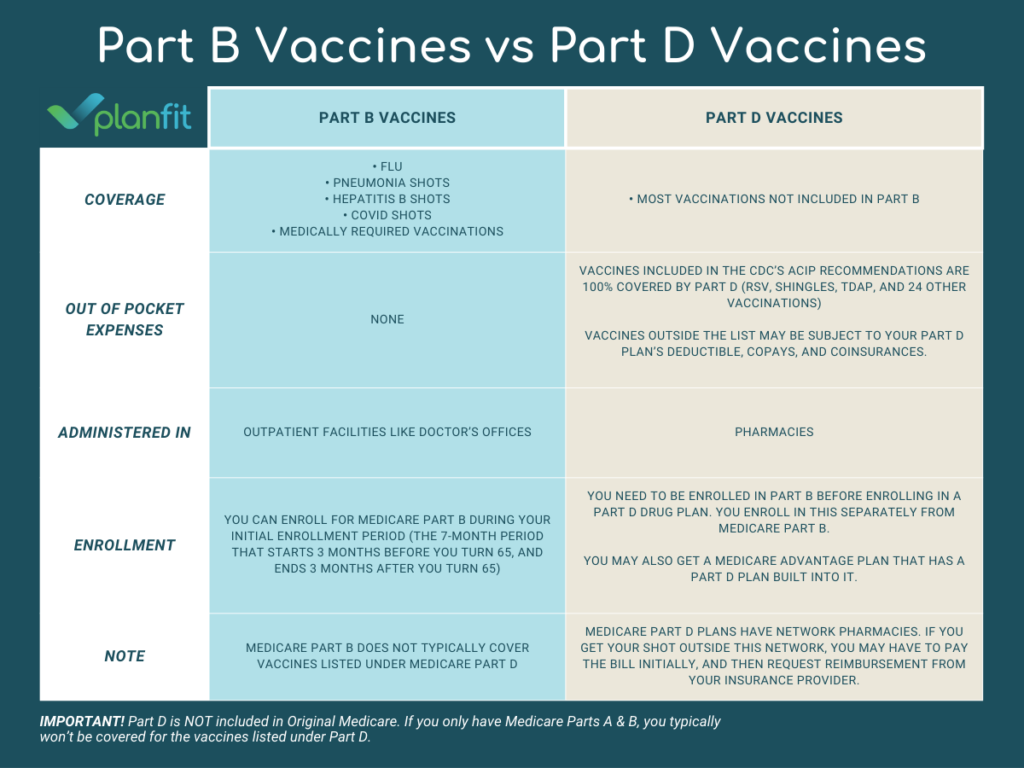
Medicare Part B typically covers vaccines that are administered in doctor’s offices. This includes vaccines like:
- Flu Shots – Medicare typically covers one flu shot per flu season (which runs from November to April).
- Pneumonia Shots – Medicare Part B usually covers your first pneumonia shot, and your second shot a year after.
- Hepatitis B Shots (if you’re at risk for the virus) – Medicare Part B should generally cover your hepatitis B shot if you’re considered at “high risk” for the virus. This includes people who have ESRD, hemophilia, or blood or body contact with an infected person; clients and staff of a developmentally disabled institution; people living with someone infected by hepatitis B; people who use certain injectable drugs; healthcare professionals with frequent contact with blood and body fluids.
- Medically-necessary vaccines – Medicare Part B typically covers vaccines that are deemed “medically-necessary,” such as rabies shots if you are bitten by a wild animal, or tetanus shots if you are wounded by a dirty object.
Medicare Part B should cover these vaccines 100%, meaning you shouldn’t have any deductibles or copays when you get these in a facility that accepts Medicare.
Which Vaccines Are Covered Under Medicare Part D?
Medicare Part D covers most commercially available vaccines that are administered in pharmacies.
Keep in mind that Medicare Part D plans are provided by licensed insurance companies and may have a network of pharmacies where you can get coverage. If you get coverage outside your plan’s network, you may not be covered or may have to request reimbursement from your plan.
The CDC’s Advisory Committee on Immunization Practices (ACIP) released a list of vaccine-specific recommendations. Your Medicare Part D plan should cover the vaccines on this list at no cost to you. The list includes:
- Anthrax
- Cholera
- COVID-19
- Dengue
- DTaP-IPV-Hib-HepB
- DTaP/Tdap/Td
- Ebola
- Hepatitis A
- Hepatitis B
- Hib
- HPV
- Influenza
- Japanese Encephalitis
- Measles, Mumps and Rubella
- MMRV
- Meningococcal
- Orthopoxviruses (Smallpox and Monkeypox)
- Pneumococcal
- Polio
- Rabies
- Rotavirus
- RSV
- Tick-Borne Encephalitis
- Typhoid
- Varicella (Chickenpox)
- Yellow Fever
When Should You Get These Vaccines?
Looking at the list of available vaccines may seem overwhelming. You might be wondering if you should get all those vaccines or how often you should get the “necessary” ones.
The good news is that the CDC released a vaccine schedule for adults that shows how often you should get certain vaccines, depending on age. For people aged 65 and above, the CDC recommends the following:
- COVID-19 – At least one dose of the current vaccine
- Flu/Influenza – Once a year
- RSV – One-time dose. Some adults aged 65+ should get the vaccine, but all adults aged 75+ should get the RSV Vaccine.
- Tdap – Three doses if not yet vaccinated, one booster every ten years.
- Shingles – All adults aged 65+ should get two doses of the Shingles Vaccine
- Pneumococcal – All adults aged 65+ should get one or two doses of the vaccine
Aside from those, the CDC also recommends getting the following vaccinations:
- Hepatitis A and Hepatitis B – Some adults aged 65+ should get two, three, or four doses of the vaccine
- Meningococcal – Some adults aged 65+ should get the vaccine. The dosage depends on the vaccine used, medical condition, and living/working conditions of the patient.
- Hib – Some adults aged 65+ should get one to three doses of the vaccine depending on their health condition
- Mpox – Some adults aged 65+ should get two doses of the vaccine.
In general, for the vaccines listed above, you should take a vaccine if it is recommended by a health professional.
What Changes Did The Inflation Reduction Act Have on Medicare’s Vaccine Coverage?
Before January 1, 2023, most vaccines covered by Medicare Part D were subject to copays and coinsurance. However, the Inflation Reduction Act removed cost-sharing for vaccines included in the CDC’s ACIP recommendations starting on January 1, 2023.
Because of the Inflation Reduction Act, you can now get vaccines in the ACIP Recommendations typically at no cost to you.
3 Potential Pitfalls For Medicare’s Vaccines Coverage
Even though you should be able to get most commercially available vaccines at no cost to you, there are three potential pitfalls to be aware of. If you fall into one of these, you may end up paying for a vaccine you could have received at no cost to you.
Let’s take a closer look.
Pitfall #1: Only Enrolling in Original Medicare
Original Medicare (Medicare Part A and B) covers some vaccines administered in doctor’s offices. However, it does not cover most commercially available vaccines. Vaccines such as RSV, Shingles, Tdap, and others are covered by Medicare Part D, not Medicare Part B.
That is why if you only enroll in Original Medicare or Original Medicare plus a Medicare Supplement Plan, remember that you won’t be covered for most vaccines administered in pharmacies. To get coverage, you may also need to enroll in a separate Medicare Part D plan.
However, if you’re enrolled in a Medicare Advantage Plan that has built-in Medicare Part D prescription drug coverage, you should be able to get coverage for most commercially available vaccines at no cost to you.
Pitfall #2: Going Out-of-Network
Medicare Advantage Plans are required to cover everything included in Original Medicare within their network of doctors and hospitals. However, if you go outside your Medicare Advantage Plan’s network, they may not cover your costs.
When it comes to vaccines covered by Medicare Part B, your Medicare Advantage Plan should cover these vaccines at no cost to you within their network of doctors and hospitals. You may have to pay full price if you get these vaccines out-of-network.
Pitfall #3: Billing Errors
Most Medicare Part B vaccines are administered in doctor’s offices, while most Medicare Part D vaccines are administered in pharmacies.
One mistake we sometimes see is when people choose to get a vaccine covered under Medicare Part D at a doctor’s office, and the doctor’s office sends the bill to Medicare Part B instead of the patient’s Medicare Part D plan. Doctor’s offices are accustomed to billing Medicare Part B, so this is a common mistake.
When Medicare Part B receives the bill, they typically reject it and send it back, since the vaccine administered is not covered under Medicare Part B.
That’s why if you decide to get a vaccine covered by Medicare Part D at a doctor’s office, make sure to tell them to bill your Medicare Part D plan, rather than Medicare Part B.
Conclusion – Vaccines Can Prevent Illnesses!
You’ve probably heard that “prevention is better than cure.” Vaccines are recommended by most doctors today for you to potentially avoid serious sicknesses.
Thanks to Medicare and the Inflation Reduction Act, vaccines are now more accessible than ever before. So, if you’re turning 65 soon, consider enrolling in Medicare and a Medicare Part D prescription drug plan (either as a standalone plan or as part of a Medicare Advantage Plan). This way, you should get the most commercially available vaccines at no cost to you!
If you need help enrolling in Medicare or finding the right Medicare Part D plan fit for you, you can also get the help of a licensed insurance agent. Licensed insurance agents contract with several different insurance companies, so they can provide you with unbiased help finding the right plan for you. Licensed insurance agents are also paid by the insurance company, so you can get their services at no cost to you!
So call or text us today at +1 877-360-6565 (TTY: 711) and we’ll be glad to assist you:

Calvin Bagley is the founder of PlanFit, The Medicare Store, and Nuvo Health. He and his team have helped over 60,000 people navigate Medicare options, and he’s a nationally recognized speaker in the Medicare industry. Most importantly, he’s someone who believes every American deserves clear, honest information without pressure.